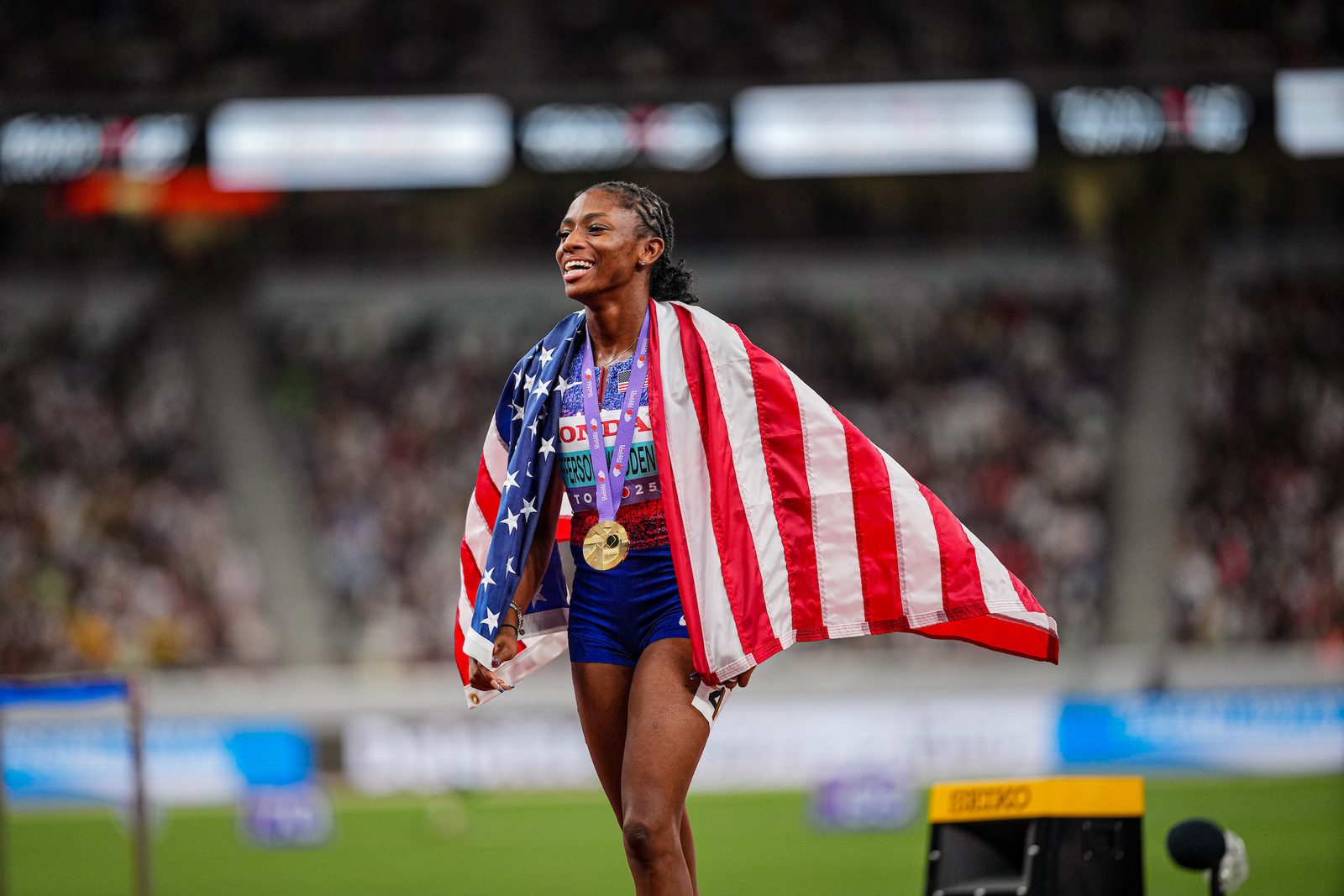
I think it’s impossible to debate that in 2025, Melissa Jefferson-Wooden had one of the greatest seasons in track & field history.
At the 2025 World Championships in Tokyo, Japan, Melissa won gold and set personal bests in both the 100m and 200m, as well as led off the gold medal winning 4x100m relay, completing the coveted sprint triple in track & field. Check out the full video I have on a complete history of the triple.
But outside of what she did at the World Championships, many started to compare her entire season to the likes of Shelly-Ann Fraser-Pryce in 2022, Elaine Thompson-Herah in 2021, or even Florence Griffith-Joyner in 1988, which are some of the other most legendary seasons we have ever seen from women in the 100m and 200m. But how does Melissa’s 2025 season actually compare to some others?
Before we take a look back through history, let’s break down what Melissa actually did in 2025, as well as a bit about who she is.
Entering 2025
Melissa Jefferson-Wooden entered 2025 having won bronze in the 100m at the 2024 Paris Olympics, as well as setting a personal best of 10.80 seconds at the USA Olympic Trials earlier that year. She had not run the 200m at all since 2023, and her PB of 22.46 actually dated back to 2022, when she was still a junior in the NCAA at Coastal Carolina. So being honest, you would be hard pressed to find many people who expected her to dominate 2025 the way she did, let alone in both the 100 and 200.
Speaking of Coastal Carolina, Melissa was not a very high profile sprinter prior to 2025. While in the NCAA, she became the 2022 indoor 60m champion, taking down the future Olympic champion Julien Alfred, who actually set the NCAA 60m record in the prelims the day before. Prior to this win, she had never even made an NCAA final, let alone been in the conversation for a title.
This shot her to the top of the conversation to win the outdoor 100m title, but she unfortunately finished 8th place. Melissa quickly bounced back to not only win the 2022 USA Championship title, but also run a windy 10.69, proving she had the ability to not only compete against the best women in the world, but also had the potential to run faster than many expected.
The Early 2025 Season
In the early part of the 2025 outdoor season, Melissa raced both the 100m and 200m at the 3 Grand Slam Track meets between April and June. She went undefeated in all three 100m races and won two of the three 200m races, her single loss being a 3rd place at the Miami Grand Slam meet behind Gabby Thomas and Tamari Davis. But despite that, she did run a massive PB of 22.15 seconds.
Probably her best early season performance came at the Philly Grand Slam meet, where she ran a PB of 21.99 seconds, taking down Olympic champion Gabby Thomas in the process. This was followed a day later with a 100m PB of 10.73 seconds, making her the 10th fastest woman in history at that point.
The 200m race in particular arguably put the world on notice that she could be a true threat in the event. Circling back to her time in the NCAA, Melissa was a consistent 200m runner, having qualified for the NCAA Outdoor Championships in both 2021 and 2022. Though her best finish was 9th in the 2022 final, she had run a best of 22.46 earlier that year, showing that she had the potential if she really committed herself to the event, something that she chose to skip out on once she turned pro.
Between spring 2022 and the end of 2024, essentially the 2+ years after leaving the NCAA, she ran just three 200m races, all in 2023 and none faster than her 22.46 PB. But the start of the 2025 season showed she had not lost a step and was on pace for something special.
Building the Case for a Legendary Year
After Grand Slam Track, Melissa ran at the Prefontaine Classic, the USA Championships and a few other Diamond Leagues in Europe before heading to the Tokyo World Championships.
In Eugene, she ran the 100m in 10.75, which was not only just off her recent PB, but she also took down Olympic champion Julien Alfred, who also ran an impressive 10.77. Also note, there was a headwind of -1.5, which is by far the biggest headwind for a sub-10.8 race in history, and probably would have given her a 10.6 race with the wind turned around.
But just to pause on this point for a second, because by early July, Melissa had already taken down the Olympic 100m and 200m champions AND essentially both Olympic podiums at some point in the season: Julien Alfred and Sha’Carri Richardson in the 100m, Gabby Thomas and Brittany Brown in the 200m. Obviously everyone was at different points in their season, but clearly Melissa was building her case for a legendary year.
Next, at the USA Championships, Melissa swept both the 100m and 200m, running PBs of 10.65 and 21.84, respectively. That 100m time notably moved her a step up to equal no. 5 all-time, sharing the spot with Sha’Carri Richardson and Shericka Jackson… at least for now. This double also made her the first woman in over 20 years to win both events at USAs. The last person to do it was Torri Edwards in 2003.
The Silesia Diamond League was next, where Melissa ran a comfortable and controlled 100m in 10.66, just barely off her recent PB, and considering the wind and location, this probably was a better performance regardless.
This now gave her 2 marks under the 10.7 second barrier, something only 4 women in history have ever done: Shelly-Ann Fraser-Pryce, Elaine Thompson-Herah, Florence Griffith-Joyner, and Carmelita Jeter. So even before we got to the World Champs, Melissa was already in legendary company.
Finally, the Brussels Diamond League was the last stop before Worlds, and she ran 10.76 in the 100m, which, funny enough, was her slowest 100m final time that year outside of her season opener in Kingston.
So for context, prior to Worlds, Melissa had gone undefeated in the 100m, won all except one 200m race, had run sub-10.70 on 2 different occasions, run sub-22 seconds on 2 occasions, and had already taken down the Olympic champions in both the 100m and 200m. She was building the case for one of the greatest seasons in history.
The Building Blocks: 2022 to 2024
After winning the 2022 USA title, she went on to qualify for the 100m final at the Eugene World Championships, and despite a last place finish, Melissa was actually extremely hopeful for her future.
In 2023, Melissa missed the 100m team after a 5th place finish at USAs, though she did run the lead-off leg in the prelims of the 4x100 at the Budapest World Champs. But really notable is that she did not break 11 seconds in the 100m the entire season.
At the end of 2023, she would go on to leave her college coach and move down to Florida to train with Dennis Mitchell and Star Athletics, which included names like Sha’Carri Richardson, TeeTee Terry, Kayla White, and some of the other top sprinters in the United States. This move immediately paid off as, in 2024, she went on to not only make the US Olympic team running a 100m PB of 10.80, but eventually secure a bronze medal at the Paris Olympics, an accomplishment that arguably put her on the map for the wider world who wasn’t as familiar with what she had done in prior years.
The 3 years between 2022 and 2024 were not easy, but were building blocks for Melissa to eventually achieve the success that would come in 2025.
Tokyo 2025
Enter Tokyo, Japan. The 2025 World Championships would be the cap to an already legendary season for Melissa Jefferson-Wooden.
She first won 100m gold and set a new personal best and championship record of 10.61 seconds, which was a full 0.15 seconds ahead of 2nd place, which essentially just solidified her dominance in the event this year: a completely undefeated season. 10.61 also now made her the 4th fastest woman in history, only behind Florence Griffith-Joyner, Elaine Thompson-Herah and Shelly-Ann Fraser-Pryce.
The 200m was arguably even more dominant though, as she won gold in 21.68 seconds, almost a full half-second ahead of 2nd place, which was the biggest winning margin at Worlds or Olympics since Allyson Felix in Osaka 2007. That time also made her the 8th fastest woman in 200m history as well. And even more importantly, Melissa became just the 12th woman to ever win the 100/200 sprint double at Worlds or Olympics.
But to fully cap things off, Melissa led off Team USA to gold in the 4x100m relay, earning her the coveted sprint triple in the 100-200-4x100, just the 7th woman in history to achieve the feat, and the 14th athlete, man or woman, to do so. Again, check out the full video for a full breakdown.
Melissa’s 2025 by the Numbers
And to just highlight a few notable stats on what Melissa did in 2025:
- She won the 100/200/4x100 sprint triple, with large margins of victory in both individual events.
- She became the 4th fastest woman in history with her PB of 10.61 seconds, and went undefeated in the 100m, averaging 10.790 seconds.
- Her 200m PB made her the 8th fastest woman in history, and though she lost one race in the year, she still averaged 22.177 in all her races.
Legendary Seasons Throughout History
So Melissa clearly had one of the most legendary seasons for any sprinter in history, but instead of doing a direct comparison of stats and numbers and all that, I think it makes more sense to just quickly highlight some of the other women throughout history who have also had historical seasons in the 100/200m.
Before getting to the Shellys and Elaines, let’s go a bit further back in time, like even before the 1980s, where you had names like Fanny Blankers-Koen in 1948, Marjorie Jackson in 1952, Betty Cuthbert in 1956, Wilma Rudolph in 1960 and Renate Stecher in 1972.
All 5 of these women won gold in the 100m and 200m during their respective seasons AND set world records in at least one of the events during that same year. Fanny, Betty, Wilma and Renate also added 4x100m medals at the Olympics to add to their year. One issue to note though is, because these women competed so far back in history, stats on everything they did throughout their full seasons are a bit hard to come by. But I couldn’t go without giving them a shout out.
The 1980s
Moving into modern times, the 1980s saw athletes like Silke Möller and FloJo really dominate certain years.
Möller won double gold at the 1987 World Champs, went undefeated in the 200m that year and ran all-time marks in both events as well.
But Florence Griffith-Joyner in 1988 almost undoubtedly had the greatest single season for a woman sprinter in history. Triple gold in the 100/200/4x100, world records in the 100 and 200 that have yet to be broken, undefeated in both events that year, and her consistency in terms of marks still holds up with the best women even today.
People, including myself, have questions around her 100m time being wind aided. But even if you remove that mark, she still set a world record of 10.61, which no one was able to match or surpass for over 30 years. When talking about a single 100/200 season, FloJo in 1988 had the depth and dominance that few, if any, women have ever matched.
The 1990s
BUT moving into the 1990s, the women were not lacking depth in any capacity.
Merlene Ottey, Katrin Krabbe and Gwen Torrence really dominated the early 90s, with Krabbe actually winning the sprint double in 1991, along with a bronze in the 4x100. Gwen won 100 and 4x100 gold in 1995, and though she was DQed in the 200m after stepping on the line, her season was very impressive, going undefeated in the 100m and only losing 2 races in the 200m.
Ottey was arguably the most consistent, with 4 really high quality seasons in 1990, 1991, 1993 and 1995. Though she never won double gold, 1990 and 1991 saw her set all-time marks in both sprints. In 1993 and 1995 she earned 200m gold and 100m silver, along with medals in the 4x100m.
But just to further highlight Ottey’s 1990 season, which didn’t have a global championship: she went undefeated in all 24 of her races, and in the 100m and 200m she moved up to no. 3 all-time and no. 2 all-time, respectively, that year. I think this year gets overlooked because there was no opportunity to win medals. And it’s impossible to know if Ottey would have won golds, but there’s no denying it was one of the greatest seasons ever.
But this directly connects with Marion Jones, who also dominated the late 90s, specifically 1998, another non-championship year. That year, Marion Jones went undefeated in all 19 100m races and 6 200m races. She also ran the 2nd fastest time in history in both events. And to cap it off, her 100m average that year was 10.796, faster than what FloJo had done in 1988.
Listen, I have my issues with Marion Jones for not only cheating in her career, but lying as well. But it’s undeniable that her year in 1998 was one of the greatest sprint seasons in history. She also dominated in 1999, but failed to medal in the 200m or relay, so it just couldn’t stack up.
The 2000s and 2010s
Entering the 2000s and 2010s is really where Jamaica began to make their presence even more known, first with Veronica Campbell-Brown.
2004 saw Veronica win 200m gold and 100m silver, but then she flipped things in 2007 by winning 100m gold and 200m silver. And though she never ran extremely fast times when talking historically, she did dominate by going undefeated in the 200m in 2004 and only losing one race in 2007, the World Champs to Allyson Felix. She also ended up on the list one more time with her 2011 season, where she won 200m gold and 100m silver, and again, almost went undefeated in the 200m, with just a single loss at the start of the year to Shelly-Ann Fraser-Pryce.
Also notable was Carmelita Jeter’s 2011 season, where she won 100m gold, 200m silver and 4x100m gold, and dropped a time of 10.70, which was slower than her 10.64 PB from 2 years prior, but still faster than anyone in history at that point except for FloJo and Marion Jones.
But speaking of Shelly-Ann, she entered the conversation in 2012 when she won 100m gold, 200m silver and 4x100 silver at the London Olympics. And though she became the 4th fastest woman all-time that year, her record of wins actually wasn’t that great in either event, actually losing more than she won.
But in 2013, Shelly stepped things up a notch and won the sprint triple in Moscow, the first time anyone had done so since FloJo in 1988, and had a much better win-loss record.
Shelly has another season on this list in 2022, but before that, 2015 saw Dafne Schippers put together a low key amazing season. Dafne won 200m gold and 100m silver, and her 200m best of 21.63 moved her up to no. 3 all-time. And the consistency that year was fully on display, winning the majority of her races in both events.
Just a year later, Elaine Thompson-Herah, who had won 200m silver behind Schippers in 2015, went on to not only win the Olympic double in 2016, but also won 4x100 silver and dropped 10.70 to match Shelly at number 4 all-time in the 100m. After some injuries, Elaine returned in 2021 to essentially come as close as possible to matching what FloJo did in 1988.
Elaine’s 2021 Olympic season saw her win the triple with gold in the 100/200/4x100, but also run times of 10.54 and 21.53, making her the 2nd fastest woman of all-time in both events. Though she wasn’t undefeated, losing 2 races each over both the 100 and 200m, her 100m average of 10.802 is one of the best in history and just showcases the consistency she displayed that year.
Jamaica’s Recent Run
But circling back to 2022, this is where Shelly-Ann Fraser-Pryce arguably had the greatest season of her career at the age of 35.
She not only won 100m gold, 200m silver and 4x100m silver, but she ran 10.6 seconds on 7 different occasions that year, which is by far the most by any woman, ultimately giving her an average 100m time of 10.713, which is honestly unfathomable when you consider Melissa’s 10.790 is the next best in history.
What’s interesting is, in 2021 Shelly was faster in both the 100m and 200m, but she only won 100m silver and failed to medal in the 200m at the Olympics, so her season as a whole can’t compare to 2022.
So if you notice, Jamaica has built up consistency, with Elaine, Shelly, Veronica and Merlene each having multiple years in the discussion. And this just caps off with Shericka Jackson adding her name to the convo in 2022 and 2023.
Shericka flips the script a bit with more success over 200m, winning gold both years, along with 100m silver both years as well. While her 2022 was special, with a 21.45 PB and an average 200m time of 21.906, only behind FloJo’s best average from 1988, Shericka’s 2023 was one for the ages: 10.65 in the 100m to become the 5th fastest woman of all-time, 21.41 to get closer to that 200m world record, and undefeated in all 200m races, many of which were 21.4 and 21.5, resulting in an average of 21.93.
Finally, I want to shout out Julien Alfred in 2024, who deserves a ton of respect for her 100m gold, 200m silver and showing all throughout the year as well.
Note that all of these women competed in both the 100m and 200m during their respective seasons and won some combination of gold and silver at the Worlds or Olympics that year. So I didn’t mention athletes like Gabby Thomas, Evelyn Ashford, Tori Bowie, or Allyson Felix, who might have dominated a single event in a specific year, like Gabby’s 2024 in the 200, or Evelyn’s 1984 in the 100m, or maybe they doubled, like Allyson in 2012 or Tori in 2016, but didn’t come away with at least gold and silver at the global championships. And yes, I acknowledge I mentioned Merlene Ottey’s 1990 and Marion Jones’ 1998, but I personally thought those years stood out particularly among the others.
And let’s be clear, there are probably a TON of other seasons I didn’t mention that stack up with some of the greatest, but these were just a few throughout history when it comes to 100/200m sprinters who Melissa Jefferson-Wooden is now entering the conversation with.
More Than the Stats
But being honest, there’s so much that the gold medals, the fast times, the averages, undefeated seasons and all those stats can’t tell us.
It can’t show Melissa becoming an unexpected NCAA indoor champion in 2022. How she lost the NCAA 100m outdoors, but bounced back to win USAs and make the World Champs final that year. How she struggled in 2023, when she missed the 100m team and only ran the 4x100 prelims at Worlds. How she left her college coach before the Olympic year, moved to a completely different state and bounced back to win Olympic 100m bronze in 2024. How the world questioned if she was running too fast too early in 2025, but she not only managed to get better, but peaked perfectly at the end of the season.
These are things that any stats comparison can’t show for Melissa, and all the other athletes I mentioned throughout history. Those are immeasurable parts of the journey to the legendary seasons they had.
But wherever you may rank Melissa’s 2025 season, either at the top, at the bottom or somewhere in the middle, I think we can all agree she’s already made history and is arguably just getting started.
Watch the Full Video