The 2025 NCAA Indoor Championships will be held in Virginia Beach at the Virginia Beach Sports Center. It’s a relatively new facility, which only opened less than 5 years ago in 2020, and since then has hosted everything from high school to NCAA meets.
But this will be the first time NCAA Indoors will be held in Virginia, and even more importantly, just the 2nd time in decades that NCAAs is being held on the east coast, only after the meet was held in Boston last year in 2024.
For a long time, athletes and coaches have been accustomed to attending NCAAs at the University of Arkansas in Fayetteville, Texas A&M in College Station, or even other sites such as Albuquerque, New Mexico, or Birmingham, Alabama, even Nampa, Idaho in 2012.
But if you notice, all of these sites are either in the south or out west. Now you would think, considering how many indoor tracks have existed in the East, there would have been at least one NCAA Indoor Championships hosted previously, either in NYC, in Boston, Virginia Tech, or Clemson.
And again, NCAAs was in Nampa, Idaho back in 2012… All due respect, but it’s crazy to think that Idaho held NCAAs before anything on the east coast.
Well, there actually was an NCAA Indoors held out east, and it went down way before many of us were even born. So let’s take a trip back through the history of NCAA Indoors to understand how we got to this point.
The First NCAA Indoor Championships
Now, the NCAA as an entity has been around since the 1920s, with the first outdoor meet being held in Chicago in 1921. But it wasn’t until 1965 that the first NCAA Indoor Championships was held. It was held in Detroit, Michigan and hosted by the University of Michigan, which was down the road in Ann Arbor.
While in Detroit, the Cobo Center, now known as Huntington Place, would construct a temporary track every winter for the championships. This occurred for almost 2 decades, until 1982 when the indoor championships would leave Detroit for the first time, moving up the road to the Pontiac Silverdome in Pontiac, Michigan for the 1982 and 1983 Indoor Championships.
The Cobo Arena actually began a massive renovation and expansion in 1981, which was eventually completed in 1989, which may have been the reason the indoor championships left the venue, but still remained in Michigan.
Additionally, women only started competing as part of the NCAA Outdoors in 1982, and then indoors in 1983, when the first combined men’s and women’s indoor championships was held.
The Meet Moves East, Then South
After 2 years in Pontiac and 19 years in Michigan, 1984 saw the NCAA Indoor Championships finally move outside of Michigan, this time to Syracuse, New York.
Held in the Carrier Dome on the campus of Syracuse University, the 1984 and 1985 NCAA Indoor Championships would be the first time we would see the event on the east coast.
From Mike Conley and Merlene Ottey, to Roger Kingdom and Carol Lewis, some of the most legendary athletes we now know in the sport today graced the track in Syracuse while they were collegiate athletes in the mid 1980s.
Unfortunately, the meet in Syracuse would be short lived as, after just 2 years, the NCAA Indoor Champs would move down south for the first time, now to the Cox Convention Center in Oklahoma City, which would play host from 1986-1988. So in the span of just 5 years from 1981 to 1986, NCAAs had moved between 4 different cities: Detroit, Pontiac, Syracuse and now Oklahoma City.
This movement wouldn’t last long as in 1989, the championships moved back up to the midwest, now being hosted at the RCA Dome in Indianapolis, Indiana. And the championships would remain here for a full decade until 1999.
From Temporary Tracks to Arkansas
Up to this point, the various locations where NCAA Indoor Champs were held had temporary tracks, meaning these venues were either convention centers or sports complexes that hosted other events throughout the year, such as concerts, basketball and football games, large conferences, auto shows, and other events. In the weeks leading up to NCAA Indoors, the space would be converted, the track built, the meet would go down, and then the track would quickly be taken down after.
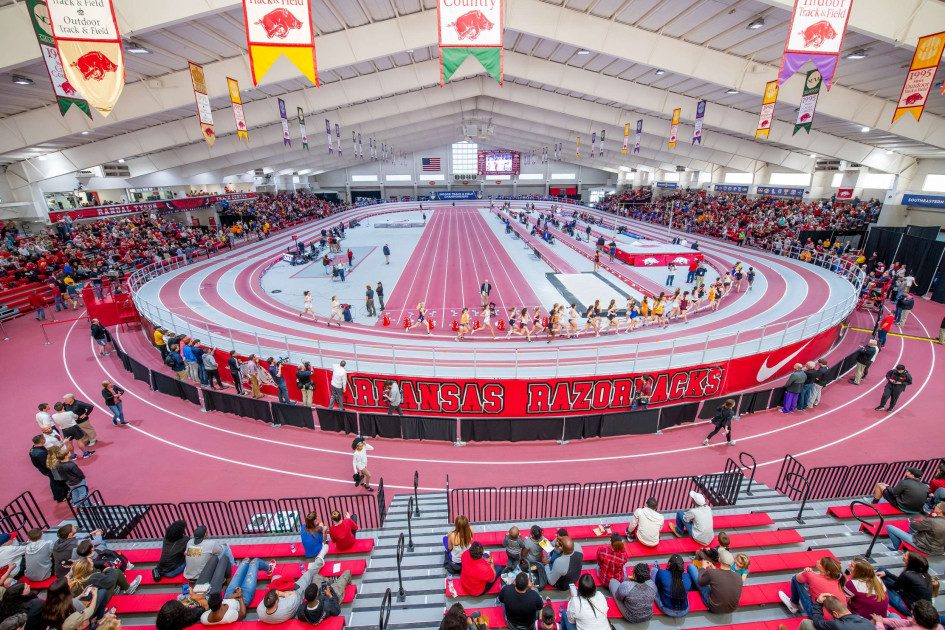
But 2000 was a shift, when the University of Arkansas opened the Randal Tyson Track Center in 2000, which was a permanent track and field facility in Fayetteville, Arkansas. At that point, the NCAA Championships were moved there, and would remain there for almost a decade through 2008.
Now, to be clear, there were other permanent indoor tracks that existed across the country: the Armory Track in NYC, the Boston University Track and Tennis Center, Harvard’s Gordon Indoor Track, Clemson’s Indoor Track Complex, Virginia Tech’s Charles Rector Facility, among others.
And notice all the venues I named are all on the east coast, and all had permanent indoor tracks constructed between the early 90s and mid 2000s, so were more than capable of hosting the meet.
But as noted, the meet remained at Arkansas for almost a decade, and produced some of the best marks in history, as the facility was made specifically for track & field, including the relatively high bank which produced extremely fast times.
A Rotating Cycle of Hosts
But as the years went on, we started to have a bit more diversity. In 2009, Texas A&M opened its new indoor facility and played host to NCAA Indoors, alternating with Arkansas from 2009-2010-2011. Then in 2012 the meet moved out to Nampa, Idaho, where Boise State hosted the meet at the Jackson Center, a track that unfortunately no longer exists, having been sold in 2021.
Fast forward over the next decade, the meet would be brought to Albuquerque, New Mexico, Birmingham, Alabama, as well as back to Arkansas and Texas A&M, all between 2013 and 2023.
Back to the East Coast
But as we circle back to 2024, 40 years after it was hosted at Syracuse University, the NCAA Indoor Championships returned to the east coast, this time at the Track at New Balance in Boston, Massachusetts. Which brings us to 2025, where the consistent cycle of rotating locations continues with the meet in Virginia Beach.
Some venues may not be as favorable to some athletes and schools due to travel, warm-up facilities, logistics, and various other factors. But I think there is a positive to having the meet move around to various locations around the country, giving athletes an opportunity to experience something new during their NCAA years. Something we unfortunately can’t say about the Outdoor meet.
Watch the Full Video