At the 2025 World Championships in Tokyo, Japan, 8 men lined up in the 100m final, with Oblique Seville of Jamaica ultimately winning gold just ahead of his teammate Kishane Thompson for silver, while Noah Lyles of the United States won bronze. After 4th placer Kenny B, also from the United States, the remaining 4 spots were occupied by 4 different athletes all from the continent of Africa: Gift Leotlela, Kayinsola Ajayi, Akani Simbine and Letsile Tebogo.
This moment marked the first time in history at least 4 African athletes qualified for the 100m final at either a World Championships or Olympic Games. Prior to this, the most ever was 3 at the 1992 Olympics in Barcelona, and in most years, either 1 or no African athletes would line up in the final.
This men’s 100m final was only the tip of the iceberg though, as the 200m final saw 3 African athletes, just behind the record 4 at the 2024 Olympics, while the 400m final also saw 4 African athletes, also an all-time record at Worlds or Olympics. And the 400 notably produced 2 medalists, the first time Africa ever had 2 athletes stand on the podium together in the event.
The Tokyo World Championships was arguably a clear representation of the growing impact African athletes have had on the men’s sprints over the past few years, and may be the sign of them not only carrying that consistency into the next few championships, but possibly becoming just as prominent as American and Caribbean athletes for the foreseeable future.
The Early Years: 1904 to 1980
But to understand the athletes of today, we have to quickly take a look back through history, specifically to 1904, the third edition of the modern Olympic Games, held in St. Louis, Missouri.
South Africa became the first African nation to compete at the Olympics, sending a small set of athletes, and would consistently do so throughout the rest of the 20th century. Some important context though is that primarily white South African athletes competed at the Games, while black or native South Africans were few and far between until the mid 20th century. Though at the 1904 Games, 2 Tswanas did compete in the marathon.
Over the next few decades, a few other African nations would begin participating in track & field at the Olympics, including Egypt in 1920, Rhodesia in 1928, Nigeria and Ghana in 1952, and Ethiopia, Kenya, Uganda and Liberia in 1956.
Notable is that, outside of Ethiopia and Liberia, all the other countries at some point competed as either a British colony or, in the case of Egypt in 1920, a British protectorate. This is pretty much the reality for most African nations throughout the 20th century. They would compete under a flag as a colony, but later gain independence and full representation at the Games. This would be until 1992, when Namibia became the final African nation to send athletes to the Games after gaining independence all the way in 1990.
When it comes to success across the sprints, between 1904 and 1980 we saw just 6 athletes make a 100m final and 2 athletes make a 200m final, while the most representation came in the 400m, with 9 athletes making finals in that time period.
The 1908 Olympics brought Africa its first ever medalist, with South Africa’s Reggie Walker winning 100m gold at the London Games. He was followed up 12 years later by fellow South African Bevil Rudd, who won 400m gold at the 1920 Olympics in Antwerp. Fast forward 40 years to Rome 1960, and Malcolm Spence, also of South Africa, earned 400m bronze. But in Munich 1972, the first athlete from outside of South Africa would stand on the podium, in the form of Julius Sang’s 400m bronze.
1968 was also a notable year, as 3 African men made the 400m final in Mexico City: Amadou Gakou of Senegal, Tegegne Bezabeh of Ethiopia and Amos Omolo of Uganda.
Also standing out was Kenya’s 4x4 team, which not only won silver at the 1968 Olympics but also gold at the 1972 Olympics, a very, very special moment for Kenya and Africa as a whole.
Though African athletes only won 6 medals across 4 sprints and relays over the 76 years from 1904 to 1980, these years were arguably the building blocks for the 80s and 90s, when all African nations would finally gain independence and become more consistent when it comes to not only making finals but getting onto the podium.
The 1980s
The World Championships were introduced in 1983, which gave athletes more opportunities to compete for medals on the biggest stage, meaning more opportunities for African athletes to make their presence known as well.
1984 was the start of this, with 3 athletes making the 400m final, matching what occurred at the 1968 Games, but this time Gabriel Tiacoh of Côte d’Ivoire secured a silver medal in the event. Nigeria was able to secure the bronze medal in the 4x400 in 1984 as well.
The Olympics were quickly followed up at the 1987 World Championships, with Nigeria’s Innocent Egbunike winning 400m silver, along with David Kitur and Tiacoh joining him in the final. Egbunike would also make the 400m final at the 1988 Olympics, and had previously competed in the 1983 World 200m final.
The Golden Era of the 1990s
After the 1980s, the 1990s arguably became what I would consider the golden era for African sprinting, with athletes making multiple finals across the 100, 200 and 400 at almost every Olympics and World Championships, all led by a few notable names.
Frankie Fredericks was arguably the most consistent sprinter of this decade as, once his country of Namibia gained independence in 1990, he immediately began to represent both his country and the entire continent to the fullest. Fredericks made every 100m final from 1991-1997 and every 200m final from 1991-1999. He won Olympic silver in both events in 1992 and 1996, was the 200m world champion in 1993, and won world silvers in 1991, 1995, and 1997. He also set the African record in both events, running 9.86 and 19.68, both in 1996, the 200m record eventually standing for over 25 years.
In the finals he was joined by multiple Nigerians, including Davidson Ezinwa, Olapade Adeniken, Francis Obikwelu, and a few others, while Emmanuel Tuffour from Ghana also made a 200m final.
The 400m also saw a huge surge in success, primarily led by Samson Kitur of Kenya and Davis Kamoga of Uganda. Kitur made 3 consecutive finals from 1992-1995, winning a pair of bronze medals in 1992 and 1993. On the other hand, Kamoga won bronze in 1996 and silver in 1997. 1993 was a notable high point, as 4 athletes made the 400m final in Stuttgart that year.
The relays also shined, with Nigeria winning 4x100 silver in 1992 and 1997, along with 4x400 bronze in 1995. Kenya won 4x400 silver in 1993, while South Africa won 4x400 bronze in 1999.
So considering 17 medals won and 33 individual athletes who qualified for finals in the decade, there’s a reason I personally consider this to be a golden age for African sprinting. But why was there such a jump in success during the 90s?
Why the 1990s?
Well, if we just quickly look back before the 1980s, as I discussed earlier, most African nations were still under colonial rule from European nations and were, for the most part, unable to compete at the Olympic Games. After a wave of independence movements in the 60s, 70s and 80s, African countries began to build up their Olympic committees and athletics federations, leading to more opportunities for athletes to compete. Once we reached the 90s, all African nations were finally competing at the World Champs and Olympic Games, and there was arguably a sense of pride across the continent, leading to the success we saw throughout that decade.
I would also argue the African boycott of the 1976 Olympics was a sort of unifying moment for the continent and created a sense of athletic pride in subsequent years. For context, the 1976 African boycott occurred as a protest of New Zealand’s rugby team touring South Africa earlier that year, basically supporting the apartheid government at the time. Many athletes who competed in the 90s were kids when that boycott occurred and grew up in the years after.
Combine this with the end of apartheid and the eventual election of Nelson Mandela as South Africa’s president in 1994, along with all remaining African countries gaining independence by 1990. This all had a huge impact on the enthusiasm and unity around the continent, if not in a structural sense, then at least in a motivational sense that translated onto the track.
The Drop-Off in the 2000s
But what also made the 1990s so notable for Africa is the relatively drastic drop-off when we enter the 2000s.
Ghana’s Aziz Zakari was consistently in 100m finals from 2000-2005, while Stephane Buckland of Mauritius made every 200m final from 2001-2005, and Eric Milazar of Mauritius made the 2001 and 2003 400m finals. Despite the lack of depth, there was also a bit of diversity, considering we saw Buckland and Milazar from Mauritius, Zakari from Ghana, Aliu, Emedolu and Fasuba of Nigeria, Dzingai of Zimbabwe, and even Fredericks still making a few finals for Namibia. But the depth of finalists had drastically fallen off this decade, and not a single African athlete stood on the Olympic or World Championship podium in any sprint event.
A relative bright spot in the 2000s was the relays though, as Nigeria won Olympic 4x400 gold in 2000 after the United States was DQed, South Africa won 4x100 gold, also as a result of the USA getting DQed, and then at the 2004 Olympics Nigeria won bronze in both the 4x100 and 4x400. So not as much relay success as the 90s, but 2 gold medals is definitely something to be proud of.
When looking back, I think the poor results in the sprints throughout the 2000s are due to a few factors, one of which may have been the lack of support by the athletics federations. As countries got farther and farther away from when they gained independence, the growing pains of becoming a nation, managing infrastructure, logistics and supporting world class athletes began to pick up. This led to some notable African athletes switching their nationality to other countries.
A good example is Francis Obikwelu of Nigeria, double world junior sprint champion in 1996 and World 200m bronze medalist in 1999. He left Nigeria to begin representing Portugal in 2000, later going on to win 100m silver at the 2004 Olympic Games.
Another notable factor is corruption and mismanagement becoming a bigger problem across the continent, spilling into athletics federations, and ultimately negatively affecting the programs that are supposed to support athletes at both the elite level and the developmental level. Corruption is not limited to Africa in any capacity; it’s well documented in countries around Europe, the Americas and around the world. But it has been particularly detrimental when it comes to investing in and managing athletics in African nations.
The 2010s Jump Start
But as we entered the 2010s, this was arguably the much needed jump start in African athletics, leading to the success we are seeing today from athletes across the continent.
In the 100m, South Africa’s Akani Simbine led the way, making finals from 2016-2019, joined by Ben Youssef Meïté of Côte d’Ivoire at the Rio Olympics in 2016. Also from South Africa was Anaso Jobodwana, who made the 200m finals from 2012-2015, ultimately winning a bronze medal at the Beijing World Champs. South Africa had also won silver in the 4x400 at the 2011 World Champs.
But the 400m specifically was easily the most commanding event for the continent, with Wayde van Niekerk sweeping gold medals in 2015, 2016 and 2017, notably breaking the world record with a time of 43.03 at the Rio Olympics in what is still seen as one of the most impressive performances in the sport, considering he ran blind out of lane 8. He also won 200m silver in 2017, coming up just short of a legendary double at the World Championships.
Botswana arguably planted its flag and made its presence known during this time, as Isaac Makwala qualified for the 400m finals in 2015 and 2017, as well as the 200m final in 2017, while Karabo Sibanda and Baboloki Thebe made the 2016 and 2017 400m finals, respectively. Finally, Kenya’s Emmanuel Korir, more known as an 800m guy, made the 2019 World Champs 400m final.
Even though this didn’t mirror the amazing success we saw in the 90s, I do think the consistency from athletes in southern African countries, really led by Wayde van Niekerk, was what the continent needed moving forward when it came to motivation.
The Present Day
So this now brings us to the present day, which, in my opinion, can almost be considered a return to the quality of Africa’s golden era from the 1990s, and we’re still only halfway through the decade.
South Africa’s Akani Simbine consistently made 100m finals, only missing the 2023 world final after a false start in the semis. Nigeria’s Enoch Adegoke snuck into the 2020 Olympic final, Kenya’s Ferdinand Omanyala made the 2023 world final, and Letsile Tebogo made both the 2023 and 2024 finals. Tebogo notably won 100m silver in 2023, becoming the first African athlete to win a 100m medal at the World Championships in history, and the first 100m medal since Frankie Fredericks at the 1996 Olympics.
The 200m would be a similar story, with Joseph Fahnbulleh of Liberia making every 200m final from 2020-2024, while Tebogo grabbed a bronze medal in 2023, but more importantly won Olympic gold in 2024, the first African to win gold in the event, and Botswana’s first ever Olympic gold medal in any event. Along with Tebogo, Carli Makarawu, Fahnbulleh and Maka Charamba gave Africa a record 4 athletes in the 200m final at the Olympics. And shout out to Luxolo Adams in 2022.
The 400m was interesting, as Isaac Makwala once again made a final in 2020, but Wayde van Niekerk, after coming back from injury, made back to back finals in 2022 and 2023, though he was unable to medal. The 2024 Olympics saw Muzala Samukonga of Zambia running to a bronze medal in the event with a massive personal best, while a young Samuel Ogazi got Nigeria back into the 400m conversation for the first time since the early 90s.
This circles us right back to 2025 where, as I noted at the top, the Tokyo World Championships had 4 guys in the 100m final, 3 guys in the 200m final and 4 guys in the 400m final, the 400m notably producing 2 medalists, the first time Africa ever had 2 athletes on the podium in the same sprint event in history.
Also, as I noted, the men’s 100m in 2025, the 200m in 2024 and the 400m in 2025 produced the most individual African finalists in each event’s history.
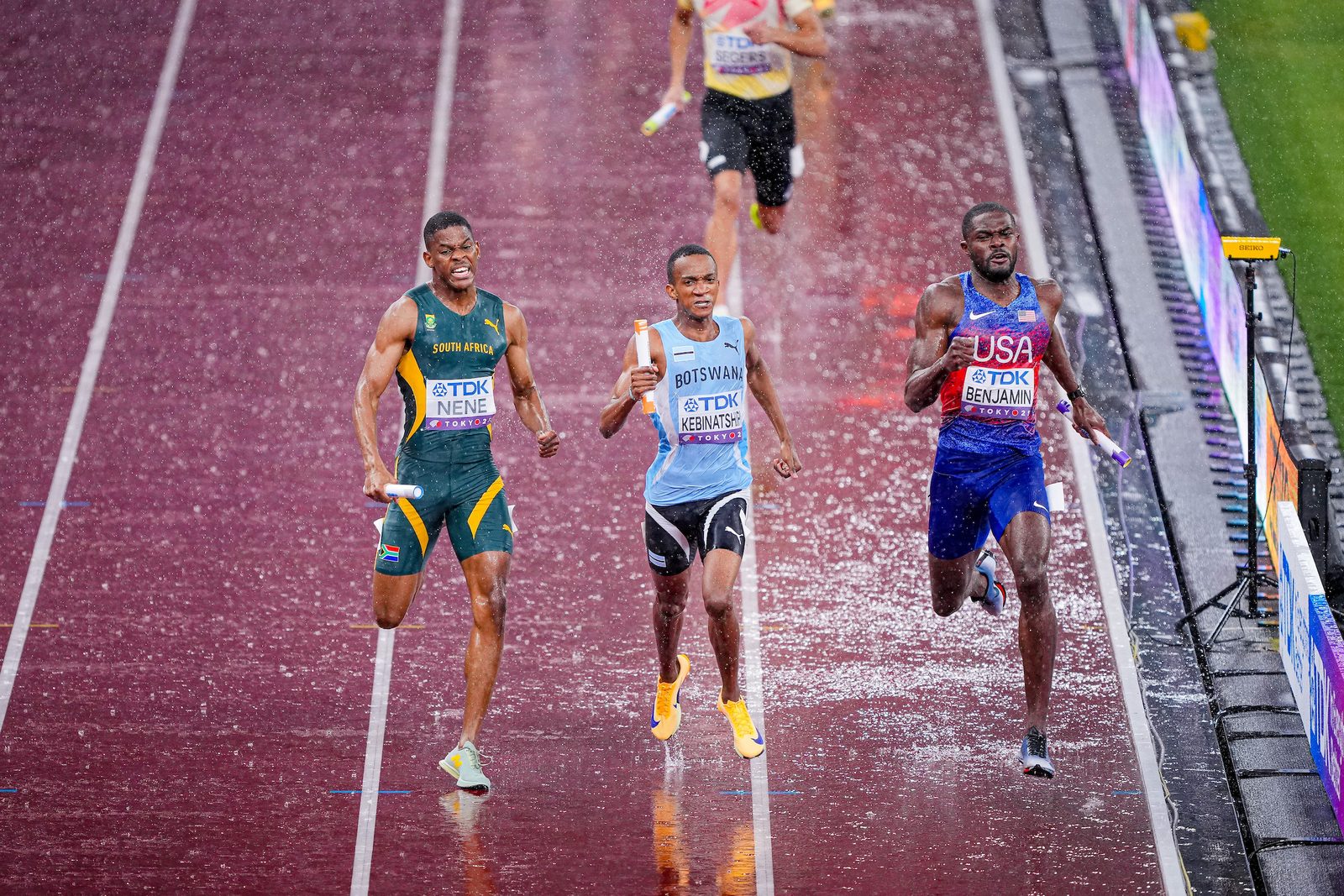
The relays also absolutely shined in recent years. After Botswana won 4x4 bronze at the 2020 Olympics, 9 years after the last relay medal for the continent, they followed that up in 2024 with a silver medal in the 4x4, while South Africa also earned silver in the 4x100 at those same Paris Olympics. Both Botswana and South Africa would come together in 2025 to win gold and bronze in the 4x4, making it the first time in history that 2 African nations stood on the podium together in any relay event at Worlds or Olympics.
All of this clearly points to this current generation bringing back the energy on the track from the 90s golden era, despite a full 5 years and 3 championships remaining in this decade.
And all of this doesn’t even factor in all the athletes who had been running fast and may have been unable to make finals for various reasons. For example, in just recent years, we’ve seen athletes like Bayanda Walaza and Abdul-Rasheed Saminu in the 100m, Tarsis Orogot and Udodi Onwuzurike in the 200m, as well as Lythe Pillay and Anthony Pesela in the 400m. There is so much quality across Africa in all the sprint events that seems to be flourishing at a level we haven’t seen in years.
Why the Resurgence?
The resurgence of success in the 2010s and into the present, I think, can be attributed to a renewed enthusiasm by athletes after a few down years, combined with more support and infrastructure, both on the continent and abroad.
Countries like South Africa, Botswana and Zambia have been able to build up home grown talent, all training in their respective nations, by way of investing directly into their athletes, their training camps, coaches and other necessary resources for success. Athletes like Akani Simbine, Letsile Tebogo and Ferdinand Omanyala all train right at home.
On the flipside, athletes like Maka Charamba and Carli Makarawu from Zimbabwe, as well as Kayinsola Ajayi and Samuel Ogazi, have been able to go abroad to the NCAA and develop there, which is more of a traditional model that still seems to work in certain cases.
But also, with the majority of sprinters in the 80s and 90s coming from East and West African nations such as Kenya, Uganda, Nigeria and Côte d’Ivoire, Southern Africa seems to have heavily invested in youth development and support for their elite athletes as well, giving rise to the likes of Collen Kebinatshipi of Botswana, Zakithi Nene of South Africa and Muzala Samukonga of Zambia, along with some of the others I noted earlier.
What Comes Next
Because of these factors, and some of the lessons learned from the past, I think this trend of African athletes not only making finals but consistently winning medals is more than likely to continue over the next few years, and arguably the next few decades as well.
And though it’s a very long way out, there is a world where we see true parity across the board when it comes to the sprints, with the United States, the Caribbean likely led by Jamaica, and African countries around the entire continent showing up and battling for medals year in and year out. The idea of it being a novelty to have Africa in the conversation will become a thing of the past, and it may become an expectation to see them on the start line in all sprint finals.
As I’ve noted, Africa has always been more than capable of producing some of the best athletes in the world. And since their first appearance at the Olympic Games in 1904, though the past 120 years have seen their success come and go, it’s very likely this current generation of African athletes firmly plants their flag in the track as a group that shows they are not going anywhere.
Watch the Full Video